East Sussex · Biocide roof treatment
Biocide roof treatment in Cliffe, East Sussex
Careful roof biocide treatment for Cliffe: a fixed quote first, then the work, done gently, and a full clear-up. Call for a fixed quote.
- Dark algae stains
- Bright lichen patches on ridge and hip tiles
- Growth coming back on a treated roof
About our roof biocide treatment in Cliffe
A treatment can be booked with a roof clean or on its own. Where growth is light, treating it may be all that’s needed, while thick moss needs removing first. We will tell you which applies. The work covers ridge and hip tiles, algae and black streaks and roofs cleaned by hand, and common reasons people get in touch are algae on an older roof and lichen that won’t scrape off.
Bungalows are common in many smaller places like Cliffe, and their low roofs are easier to reach, though the moss on them is just as stubborn. Access is planned after we’ve seen the roof, from the ground, from pictures or on a visit.
It’s worth knowing exactly what a guarantee covers. Ours is a written 12-month workmanship guarantee, and it covers the quality of our work. It isn’t a promise that moss, algae or dirt won’t return, because nobody can honestly promise that outdoors.
- Where
- Cliffe (BN7, BN8)
- Wider area
- East Sussex
- Our guarantee
- Workmanship guaranteed in writing for 12 months
- Quote
- Fixed quote, agreed before any work
- Experience
- Fully insured, with 20 years’ experience
- Call
- 01342 344 936
- Reviewed
- 30 October 2026
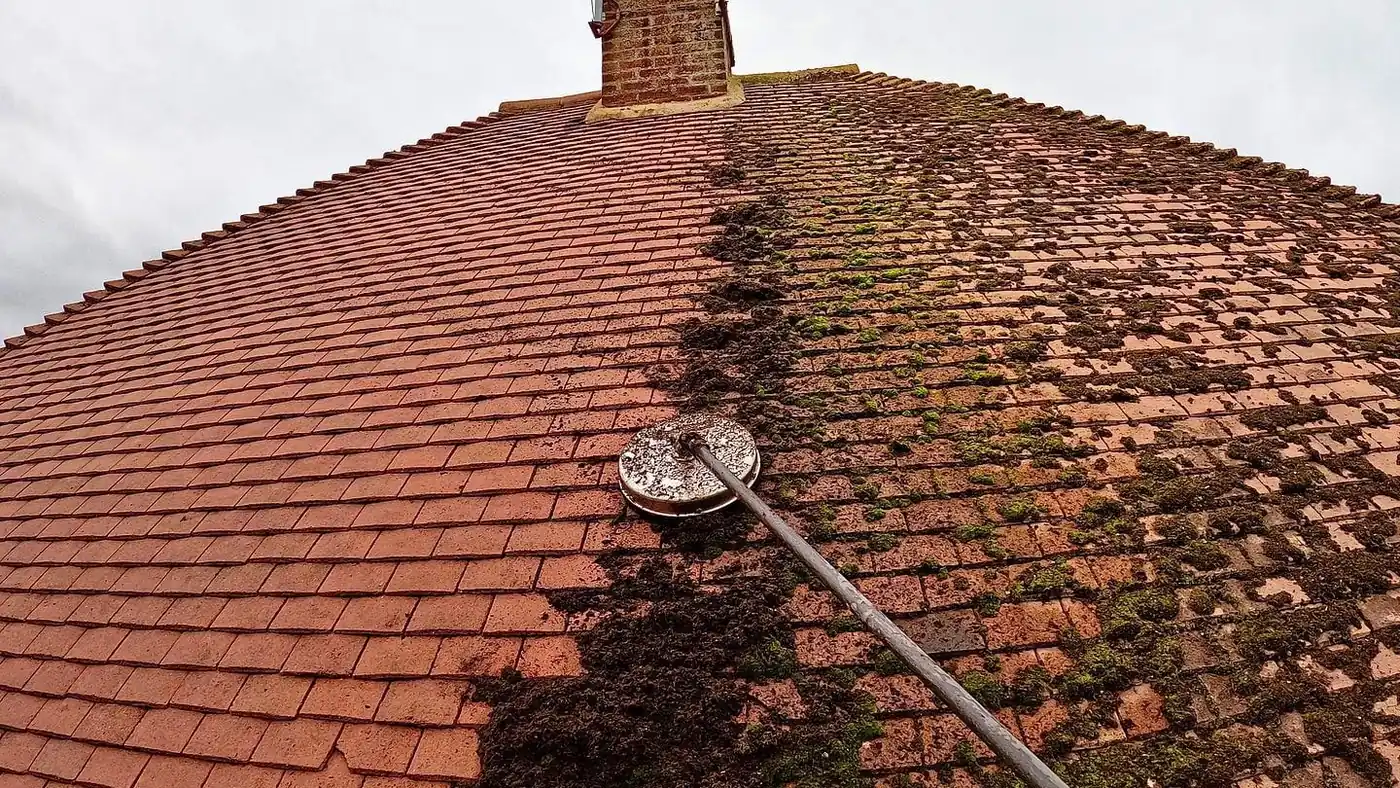
The process
Where the work is near a shared boundary, we take the same care on their side, and a word with them beforehand helps. We keep splashes and debris off nearby windows, cars and paths. The job takes a few hours on the day, while the treated growth weathers away over the following months. Bigger gardens in places like Cliffe can mean a longer walk with equipment, so tell us how we reach the back.
- First we check the tiles and what’s growing.
- We fix the price and agree any hand removal first.
- A dry day is chosen and plants, paths and drains are protected.
- The biocide goes on at low pressure, as the label directs.
- We tidy up and explain how the growth will fade over time.
A few things to sort first
- Tell us about anything you already know, such as leaks or loose tiles
- Tell us about parking restrictions near the property
- Close windows, doors and roof lights near the work
Your fixed quote
If you need roof biocide treatment in Cliffe, send a message through our quote form, or call us on 01342 344 936. Let us know where the property is and what needs doing, and mention anything that could affect access, like a conservatory below or a narrow side passage. A fixed quote follows from there.
Read more
Fixed quotes for roof biocide treatment in Cliffe
We settle the price before we arrive. We base it on:
- More than one service on one quote
- The amount of build-up
- The height and pitch, where the work is above ground
- Extras such as gutter clearing or a biocide treatment
Whatever the property, the quote works the same way: the size of the job, the access, the condition and the method. Ask for a fixed quote and we’ll go through it with you.
Photos for a quote
What to send for a quote:
- If the property is listed or historic
- Where we could park, and any restrictions
- The parts that bother you most, zoomed in if your phone allows
- The route round the side or back of the property
Want a quote for roof biocide treatment? Please send a message through our quote form, or phone 01342 344 936 with a few details. We will talk you through how we’d do it and send a fixed quote before you commit to anything.
Keeping it in good shape
A yearly look from the ground goes a long way. Beyond that:
- Give the treatment time to work
- Keep gutters running freely
- Trim branches that shade the roof
- Check the roof annually
Expect lichen to be the slowest to fade. The dead crust clings on for some time before rain and weather take it away. That’s normal and part of doing it safely.
The SPAB suggests a seasonal brushing down to control the build-up. Only where it’s safe to reach the roof, but it makes each treatment go further.
What we are called out for in Cliffe
Lichen takes years to build up, but it’s stubborn once it does. It grips the surface firmly, so it’s best treated rather than scraped.
Homeowners usually contact us after spotting something like this:
- A north-facing slope that greens up fast
- Bright lichen patches on ridge and hip tiles
- Clinging growth that would mark the tiles if scraped
- Algae on an older roof
Streets near a church such as Church of St Thomas at Cliffe often include older homes, and older clay or slate roofs need hand cleaning rather than pressure.
What your quote should include
- Whether extra work needs your agreement
- Exactly what’s included, area by area
- Whether the waste is taken away
- Whether the workmanship is guaranteed in writing
For landlords and letting agents
Empty periods between tenancies or holiday bookings suit outside work well because access is easy then. Let us know the window you’re working to and we’ll try to fit around it.
From a single let house to a portfolio, the standard is the same: a fixed price up front, the gentlest method that works, a proper clear-up and a 12-month workmanship guarantee in writing.
Cliffe roofs and what affects them
From Cliffe, the South Downs National Park is no more than about 1 mile away. Countryside such as the South Downs brings trees and damp air close to many homes, and roofs nearby can carry heavier moss as a result. Cliffe lies roughly 44 miles from central London, comfortably inside the patch we cover. You get a fixed quote, a fully insured team and a 12-month written guarantee covering our workmanship. One of the historic houses in the area is Anne of Cleves House, some 0.7 miles south-west of Cliffe. Buildings like that show how long clay and slate roofs can last when they are looked after.
Living close to Priory School can mean parked cars and crowds at the start and end of the school day. A quick note about it when you book helps us plan where to unload. Living near Railway Land, less than half a mile from the centre of Cliffe, can mean more trees, shade and leaf fall. Shade slows how quickly a roof dries, and a roof that stays damp suits moss.
Cliffe is about 1 mile east of Lewes, in East Sussex. If you need roof biocide treatment in Cliffe, it’s easy to get a fixed quote: please use the form on our contact page, or call 01342 344 936. Our area covers London and the South East, Cliffe included. Our East Sussex coverage runs to 289 places, and Cliffe is one of them. Our Brighton page covers homes nearby, about 7 miles away.
Postcode districts we cover here for roof biocide treatment: BN7 and BN8. Local streets include Ham Lane, New Road and Court Road, all of which we cover for roof biocide treatment. Main roads around Cliffe include the A26, which makes travel easy for roof biocide treatment. Neighbouring places we cover for roof biocide treatment include Southover (1 mile south-west), South Malling (1 mile north-west), Lewes (1 mile west), Hamsey (2 miles north) and Offham (2 miles north-west). Within a short drive, we also cover Eastbourne (13 miles south-east), Seaford (8 miles south-east), Hailsham (10 miles east), Crowborough (14 miles north-east), Uckfield (7 miles north-east) and Newhaven (6 miles south).
Landmarks near Cliffe
Properties near Gardeners Arms, Railway Land and Lewes Old Grammar School are covered too, along with the rest of Cliffe. Cliffe has its own railway station: Lewes station. Well-known places in the area include Museum of Agricultural Bygones (3.5 miles north-east) and Lewes Castle (0.5 miles west). Open spaces near Cliffe include Cliffe Hill and Malling Down.
Cliffe questions
Do you cover smaller places like Cliffe?
Yes. Cliffe is within the area we cover across London and the South East. Just mention lanes, gates or anything else about getting there when you book.
Does being near the South Downs affect roof biocide treatment in Cliffe?
The South Downs National Park is within about 1 mile of Cliffe. Older roofs in the countryside are cleaned by hand, with no pressure on clay or slate.
What do I need to do before you arrive?
Please move cars, leave gates unlocked and keep pets inside, and tell us about a conservatory, glass roof or nesting birds.
Can you work on an old or listed property?
Yes. We use the gentlest methods on historic roofs and walls, like hand brushing and low-pressure steam where suitable. For anything that would change the appearance, such as a coating, check with the council first, because listed building consent can be needed for works affecting its special character.
What happens to the waste?
We collect it and take it with us. Moss, leaves and debris are gathered as the work goes on, rather than letting it wash into drains or flower beds.
Can letting agents book you?
Yes. Tell us who we should deal with and how access works, and we will arrange the visit. We’ll let whoever booked us know about anything that needs attention.
How long will the treatment keep moss away?
That varies with shade and aspect, typically around one to a few years. Check the roof each year for regrowth, and treating early keeps the job small.
Do you control the run-off?
Where water is part of the job, we plan where it goes before any work starts. Debris is caught and bagged, drains are protected and gutters are kept running to the right outlets, and nothing is hosed into the road.
Honest limits
We’ll always give you a straight answer, so here’s what roof biocide treatment will not do:
- Stopping new spores landing
- Fading and old staining in the tile
- Heavy moss cushions
If in doubt, speak to us on 01342 344 936 or send details through the form on our contact page and we’ll say what we think before you book.
What we work on in Cliffe
- Ridge and hip tiles
- Shaded roof slopes
- Roofs cleaned by hand
- Tile and slate surfaces
- Lichen patches
- Algae and black streaks
What the work involves, part by part
Natural slate
Slate is brittle and can be lifted by pressure. The treatment goes on at low pressure and plan access to avoid walking on them.
Concrete tiles
Treating concrete tiles avoids stripping their colour. It’s applied at low pressure and does its work over time.