Greater London · Biocide roof treatment
Biocide roof treatment in Clay Hill, Greater London
Need roof biocide treatment in Clay Hill? We look at the job first, send you a fixed quote and use the gentlest method that works, finishing with a full clear-up.
- Black lines on the tiles
- A shaded slope that turns green quickly
- Lichen that will not scrape off
Roof biocide treatment in Clay Hill
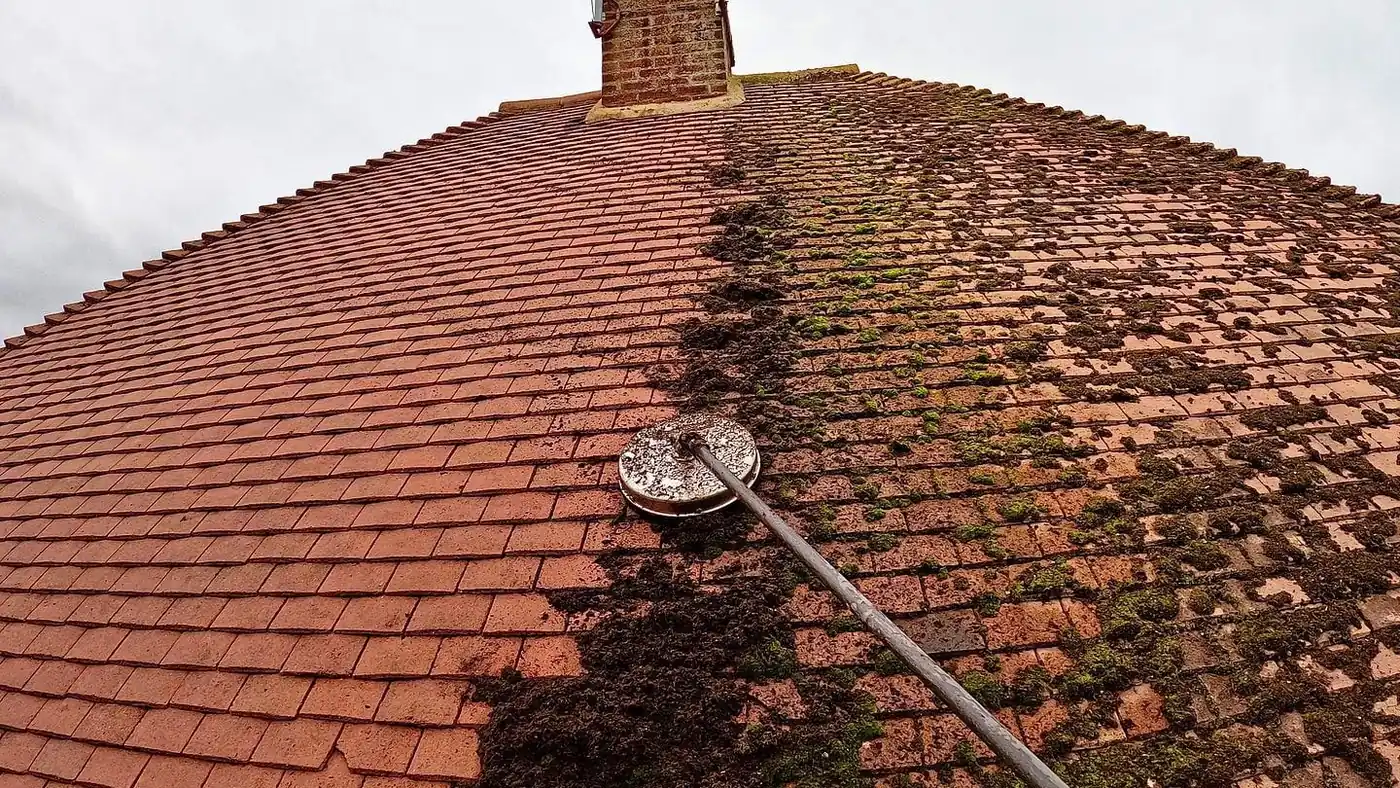
Using a biocide on a roof isn’t something to take lightly. We only use biocides approved or authorised for this use in Great Britain, as the law requires and we follow its label to the letter. The label decides how much, when and how. The work covers roofs cleaned by hand, ridge and hip tiles and shaded roof slopes, and the jobs we see most are a green film over the tiles and wanting to slow regrowth after a hand clean.
Many London roofs are shared at the edges, with party walls, shared gutters and a neighbour’s slope running into yours. We bag the moss as we go and keep the slurry out of next door’s gutter and the drains in the street, so it’s worth letting the neighbours know the day we’re coming.
We have 20 years’ experience in this work, and we’re happy to put our name to it: every job carries a 12-month written guarantee covering our workmanship. We’re also fully insured and a Checkatrade member.
- Where
- Clay Hill (EN2, EN1)
- Region
- Greater London
- Cover
- Written 12-month workmanship guarantee
- Price
- Fixed quote, agreed before any work
- Background
- Checkatrade member, fully insured
- Call
- 01342 344 936
- Reviewed
- 30 October 2026
Can I do it myself?
It’s easy to damage a surface while scraping moss. Lichen grips tightly, so scraping it can damage the tile, so it’s better treated and allowed to weather off. Leave the roof to someone with the right access.
Please do not walk on the tiles. Weight on a tile can leave hairline cracks that aren’t visible, which frost can widen over time. Proper access, planned to suit the roof, avoids that.
Roof biocide treatment around Clay Hill: what to know
Count the conservation areas within two miles of Clay Hill and you get about 4; the nearest is the Clay Hill conservation area, about 0.3 miles west of the centre of Clay Hill. Cleaning doesn’t change how a roof looks, but a coating can, so in a conservation area it’s worth checking with Enfield council before anything beyond a clean. London roofs often have hidden valleys and parapet gutters at the back, where moss collects out of sight, so the whole roof is looked at, not just the front. The area’s older buildings include Forty Hall, roughly 0.7 miles east of Clay Hill. Roofs on buildings like that have lasted because they were looked after, not because they were left alone.
If your home backs onto green space such as Enfield Town Park, 1.6 miles south of Clay Hill, you’re likely to see more shade, leaves and bird droppings. Shade slows how quickly a roof dries, and a roof that stays damp suits moss. Traffic for St John's CofE Primary School can make the road outside hard to use at certain times of day. If that’s your road, mention it when you book, and setting up can be planned around the busy times.
Clay Hill is about 1 mile north of Enfield, in Greater London. Whether your home in Clay Hill is a terrace, a semi or a detached house, we can take on roof biocide treatment. One number covers every area we work in, so booking is simple. Clay Hill is one of 764 places in Greater London we cover for roof biocide treatment. London is in our area too, around 12 miles away.
Postcode districts we cover here for roof biocide treatment: EN2 and EN1. That includes homes on Cedar Road, Flash Lane and Acacia Road and the roads around them. Neighbouring places we cover for roof biocide treatment include Gordon Hill (1 mile south), Forty Hill (1 mile south-east), Crews Hill (1 mile north-west), Bulls Cross (1 mile east) and Enfield Chase (1 mile south-west). Further out, we also cover London (12 miles south), City of Westminster (11 miles south), Marylebone (11 miles south), Kensington (13 miles south-west), St Pancras (10 miles south) and Shoreditch (10 miles south).
Landmarks near Clay Hill
Around Clay Hill, homes near Chace Community School, Rose and Crown pub and Enfield Town Park are covered too, along with the rest of Clay Hill. The nearest railway station is Gordon Hill station, about 0.8 miles south-west. A little further out are Edmonton Green Shopping Centre (3.5 miles south) and Museum of Enfield (1.5 miles south). Not far away are Fir and Pond Woods and Pole Hill.
Why act early in Clay Hill
Lichen can be scraped or treated. Scraping risks damaging the tile surface because lichen grips so tightly whereas a treatment lets it fade without harm. London homes share walls and gutters, so small problems seldom stay put.
Where the work is at height, access can make a big difference. If a tower, scaffold or powered access is needed, it goes into the quote, and we explain why it’s needed.
Why us?
- Roofs treated as fragile until we know otherwise
- A Checkatrade member
- Sludge and dirty water kept out of surface water drains
- Every job backed by a written 12-month workmanship guarantee
Places near Clay Hill
What else we do in Clay Hill
Your questions about roof biocide treatment in Clay Hill
Which council covers Clay Hill for listed buildings and conservation areas?
Clay Hill comes under Enfield council. They can confirm whether your home is listed or in a conservation area. A plain clean leaves a roof looking as it did; a coating or new tiles on a listed home are matters for the council.
Does tree cover around Clay Hill affect roof biocide treatment?
Typically, yes. Ancient woodland such as Whitewebbs Wood lies roughly 0.5 miles north of Clay Hill. Shade keeps a roof damp, and moss grows best on damp, shaded slopes, so roofs under trees may need cleaning more frequently.
Do you give a guarantee?
Our written 12-month workmanship guarantee covers the work we carry out. It’s in writing, so you know exactly what it covers, and it sits alongside our insurance.
What do you do with what you remove?
We take it away at the end of the job. Paths, patios and drives are swept clear before we go, so the property is left tidy.
How often does a roof need treating?
No one can give a fixed figure honestly. Typically around one to a few years, depending on shade and aspect since new spores never stop landing.
Do you work on rented properties?
Yes. We can quote for several properties together, with each priced on its own work. Send the addresses and how access works.
Do you work on listed or historic buildings?
Yes, with care. We don’t use pressure on historic surfaces, and we won’t apply a coating without the council’s advice, and we will suggest the gentlest method that works. The council’s conservation officer can tell you if consent is needed.
How long will the treatment take to apply?
On the day, it takes a few hours to apply on most roofs. The effect builds over the following weeks and months.
Let and managed properties
When you cannot be there yourself, we let you know when the work is done and flag anything that needs attention, like a cracked tile or a blocked downpipe. Nothing extra is done without your say-so.
On a let property, the outside is easy to overlook. Tenants don’t often check the roof or gutters, so planned work helps catch moss, blockages or slipped tiles before they grow into a bigger job.
How a job runs
Before we leave, you are welcome to walk round with us. We point out anything we spotted along the way, like a cracked tile or a gutter that is not running. On site, the work takes part of a day for many homes, depending on the size of the roof and the access. Terraces in London rarely have side access, so the route to the back is agreed before the day.
- We check the growth and the tiles before deciding the approach.
- The treatment and a fixed price are agreed with you.
- A dry spell is chosen, as the label requires.
- We protect the area below and apply the biocide by soft wash.
- You are told how the treated growth will weather off over time.
Helping the day go smoothly
- Shut nearby windows and roof lights
- Move cars off the drive and away from the work
- Clear pots, furniture and washing lines from the area
Get a fixed quote
Photos are enough for some jobs, while others need a visit. Big jobs, awkward access and anything that’s hard to see from the ground are normally looked at in person. Either way, the price is fixed before anything is booked.
Related advice
What affects the cost of roof biocide treatment
Your quote is based on your property. We take into account:
- Any towers, scaffold or powered access
- The height and pitch, where the work is above ground
- Whether anything else is added, like clearing the gutters
- Repairs found during the job, quoted before they’re done
Houses, bungalows and flats are all priced the same way: how much there is, how we reach it, what state it’s in and how we’ll tackle it. Ask for a fixed quote and we will explain each part.
Helping us quote
There’s no need to go up a ladder for pictures; the ground or an upstairs window is plenty. The most helpful are:
- The address and the type of property
- Any listing you know about
- Conservatories, porches or extensions under the area
- Photos showing the whole area to be worked on
Photos are often the quickest route to a quote: the whole area, the worst patches and the way in. Please take them from the ground, never from a ladder.
Part by part
Natural slate
Heavy moss on slate is hand-brushed first. Treatment follows to hold it back.
Fibre cement slates
Treatment is a low-impact option for fibre cement. It’s often the most suitable approach, after a careful look.
When to call us in Clay Hill
Every roof is exposed to spores, all the time. They’re carried in the air and settle on the tiles, and when the roof stays damp, they grow. Treating the roof interrupts it for a while.
Keep an eye out for any of the following:
- New moss on a cleaned roof
- A roof cleaned a few years ago that needs retreating
- Bright lichen patches on ridge and hip tiles
- A north-facing slope that greens up fast
Older homes, like many found near churches such as Church of St John the Baptist, often have clay tiles or slate that call for a gentle approach.
What to look for in a quote
- What insurance they carry
- What happens if they find damage, and whether repairs are quoted first
- What happens to the dirty water and sludge
- What access equipment they’ll use, if any