Hertfordshire · Biocide roof treatment
Roof Biocide Treatment in Bygrave
Biocide roof treatment in Bygrave, with your property protected throughout. We plan the access, protect the area and take the waste with us.
- A green film over the tiles
- Orange or yellow lichen on the ridge
- New moss on a cleaned roof
FAQs for Bygrave
Do you work in villages like Bygrave?
Yes. Small places get the same service as large ones, and Bygrave is on our list. Directions and a note about parking help us plan the day.
Who can tell me if my home in Bygrave is listed?
The council to speak to is North Hertfordshire council. The council’s conservation officer can say whether your home is listed and what needs consent. If your home is listed, listed building consent is needed for works that affect its special character, so check with the council before a coating or any change to how the roof looks.
Does maintenance matter for my home insurance?
Many policies exclude gradual damage and wear and tear, so maintenance matters. Only your insurer can say what your policy covers, but keeping the outside of your home in good order is part of good upkeep.
Will a biocide get rid of lichen?
By treating it, not scraping it. Lichen bonds tightly to tiles and slates, so scraping risks damage. Treated lichen weathers away gradually.
How long does a biocide treatment take?
Size and access decide it. Typically it takes a few hours on the day, while the treated growth weathers away over the following months and the results build for months.
Do you pressure wash?
It depends on the surface. On most hard paving, pressure washing is normal, while on roofs it’s kept for robust tiles, after a check. We never pressure wash clay, slate, old or fragile tiles, or solar panels.
How much does roof biocide treatment cost in Bygrave?
It depends on the job, so we quote each one individually. For a quote, have a word with us on 01342 344 936 or send details through the form on our contact page and tell us roughly what needs doing.
What about my pets and plants?
Plants, ponds and borders below the work are protected and keep run-off under control. Any biocide is applied at low pressure, only as the label allows, using products approved or authorised for this use in Great Britain. Keep pets indoors until we’ve finished.
Roof biocide treatment in Bygrave
Lichen is the growth that most often needs a biocide. Trying to scrape it away risks marking the tiles, so we treat it instead and let the weather finish the job. Expect it to fade gradually. Common call-outs are for an old treatment that has worn off and algae on the slope that gets the least sun, across roofs cleaned by hand, tile and slate surfaces and lichen patches.
Older villages often have listed buildings and conservation areas, which makes gentle cleaning even more important. For anything beyond cleaning, such as a coating, the council’s conservation officer is the person to ask first.
There are two kinds of protection when we work for you. We’re fully insured while we’re on site, and afterwards a written 12-month workmanship guarantee covers our workmanship.
- Where
- Bygrave (SG7)
- Wider area
- Hertfordshire
- Our guarantee
- A written 12-month guarantee on our workmanship
- Quotes
- A fixed quote up front
- Track record
- Checkatrade member with 20 years’ experience
- Call
- 01342 344 936
- Updated
- 30 October 2026
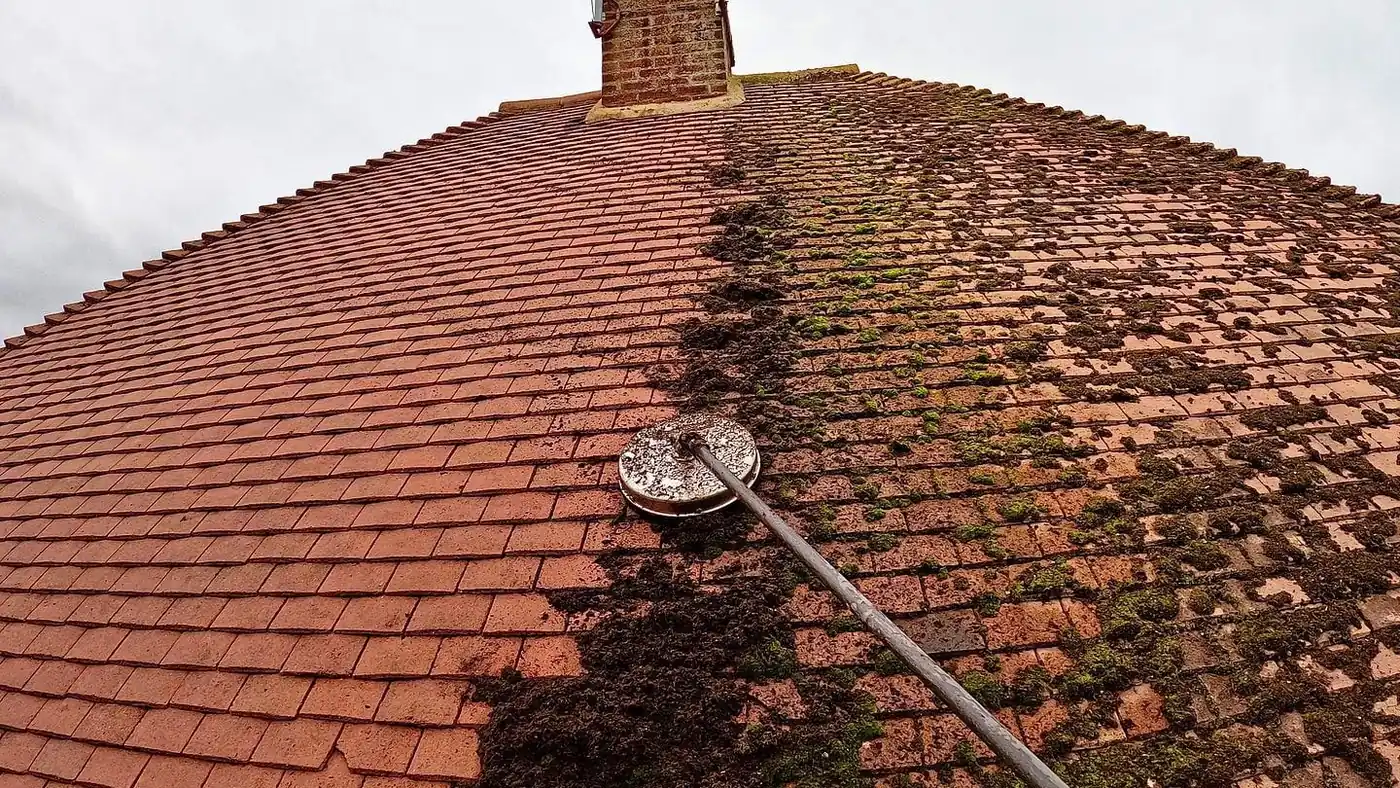
Signs you need roof biocide treatment in Bygrave
Lichen takes years to build up, but it’s stubborn once it does. Its crusts bond tightly to tiles and slates which is why a biocide is the usual answer.
Any of these is worth getting checked:
- Light moss starting to show
- Growth coming back on a treated roof
- A roof greening up
- A north-facing slope that greens up fast
Homes on school roads, near The Knights Templar School for instance, can face busy mornings and afternoons. It’s worth a mention when you book, as the van and ladders need space outside.
Questions to ask before you book
- Whether they’re fully insured
- How VAT is shown on the quote
- The method they’ll use, and why it suits your surface
- Which treatment they’ll apply, if any
What roof biocide treatment can’t fix
Before booking, it helps to know what’s not included:
- Colour lost over the years
- A roof that stays clear forever
- Broken ridge mortar
If in doubt, fill in our quote form, or phone 01342 344 936 and we will say what we think.
Surfaces we cover
- Tile and slate surfaces
- Algae and black streaks
- Lichen patches
- Ridge and hip tiles
- Shaded roof slopes
- Roofs cleaned by hand
Keeping it in good shape
Checking things once a year makes a difference. Beyond that:
- Trim branches that shade the roof
- Clear leaves from the gutters each autumn
- Leave lichen to weather off after treatment
- Look for regrowth on the shady slope once a year
After a biocide treatment, nothing much seems to happen at first. Over the following weeks and months, the growth dies back and weathers away and the roof keeps improving. We’ll tell you what to expect.
The SPAB suggests a seasonal brushing down to control the build-up. It needs safe access, but it makes each treatment go further.
Why act early in Bygrave
Leaving lichen and algae untreated lets them keep spreading. Algae holds moisture and paves the way for moss, and lichen keeps building its crust. Treating now slows it down. Old materials can be hard to replace like for like, which makes looking after them worthwhile.
Every property is different, so each one gets its own fixed quote. Size, height, access, the condition of the surface and the method all play a part.
Why choose Superior Roof Cleaning in Bygrave
- Access planned to suit the property
- Fixed prices, agreed before any work
- We take the waste with us
- A Checkatrade member
Places near Bygrave
More services for Bygrave
Different parts, different methods
Clay tiles
Clay roofs are well suited to a low-pressure treatment. Damp makes clay tiles in particular more prone to delamination, Wienerberger notes so slowing regrowth is worthwhile.
Fibre cement slates
Treatment is a low-impact option for fibre cement. That’s why it’s often what we’d suggest for these slates, after a careful look.
DIY or a professional?
For a quick check from a ladder, make sure it’s on firm, level ground, footed or tied, and do not overreach. Do not climb from the ladder onto the roof and never do it on your own.
Shop-bought moss treatments are an option for some surfaces, but only use one authorised for that job and follow the label to the letter. Applying it to a roof still means working at height, and it must be kept away from drains and ponds.
How the job works
The day has three parts: getting ready, doing the work and clearing up. Setting up covers protection, access and planning where any water will go, while clearing up means bagging the waste and taking it away. The middle part takes longest, which takes part of a day for many homes, depending on the size of the roof and the access. Tell us if anything blocks access to the work, from a gate to a parked car.
- First we look at the growth, from pictures or in person.
- Thick moss is planned for hand removal before treatment.
- We protect plants, paths and drain outlets.
- We apply the treatment by soft wash, following the label.
- We clear up and take any waste with us.
A few things to sort first
- Let us know about earlier repairs or treatments
- Check with neighbours if we need to use a shared drive
- Let us know where we can park
Your fixed quote
If you need roof biocide treatment in Bygrave, pick up the phone and call 01342 344 936, or use the quote form. Tell us the address and what you’d like done, and mention anything that could affect access, like a conservatory below or a narrow side passage. We’ll then send you a fixed quote.
Advice
Roof biocide treatment in Bygrave: the local picture
Bygrave comes under North Hertfordshire council. If your home is listed, listed building consent is needed for works that affect its special character, so check with the council before a coating or any change to how the roof looks. Among the historic houses near Bygrave is Hinxworth Place, roughly 2.9 miles north-west of Bygrave. They are proof that a roof treated gently can stay in good order for a very long time. Central London is about 35 miles away, and Bygrave is firmly within our roof biocide treatment area. We have 20 years’ experience and are fully insured.
If you live near Baldock station, about 1.3 miles south-west of Bygrave, on-street parking may be busy in the day, and our van needs to be fairly close to the house, so let us know the options. If you live near Church of St Margaret of Antioch, or on any of the older streets in Bygrave, your roof may be clay or slate, which is cleaned gently by hand.
Bygrave is about 3 miles north-east of Letchworth, in Hertfordshire. Roof biocide treatment in Bygrave is quoted and carried out the same way as everywhere else: carefully, with a fixed price and a written guarantee on our workmanship for 12 months. 381 places in Hertfordshire are on our list, large and small. We also work in London, about 35 miles from Bygrave.
Postcode districts we cover here for roof biocide treatment: SG7. If you need roof biocide treatment at a property on Wedon Way and Ashwell Road or a nearby road, we can help. Neighbouring places we cover for roof biocide treatment include Newnham (2 miles north-west), Caldecote (2 miles north-west), Ashwell (3 miles north), Ashwell End (3 miles north) and Bury End (3 miles north). Larger places within reach include Stevenage (7 miles south), Welwyn Garden City (14 miles south), Harpenden (15 miles south-west), Hitchin (6 miles south-west), Hertford (15 miles south) and Letchworth (3 miles south-west).
Around Bygrave
Bygrave’s nearest station is Baldock station, roughly 1.3 miles south-west. Well-known places in the area include Stotfold Watermill & Nature Reserve (2.5 miles west) and Bygrave House (within half a mile north-east). Green spaces nearby include Arlesey Old Moat and Glebe Meadows.