Kent · Biocide roof treatment
Broom Street roof biocide treatment
Roof biocide treatment in Broom Street, with your property protected throughout. We plan the access, protect the area and take the waste with us.
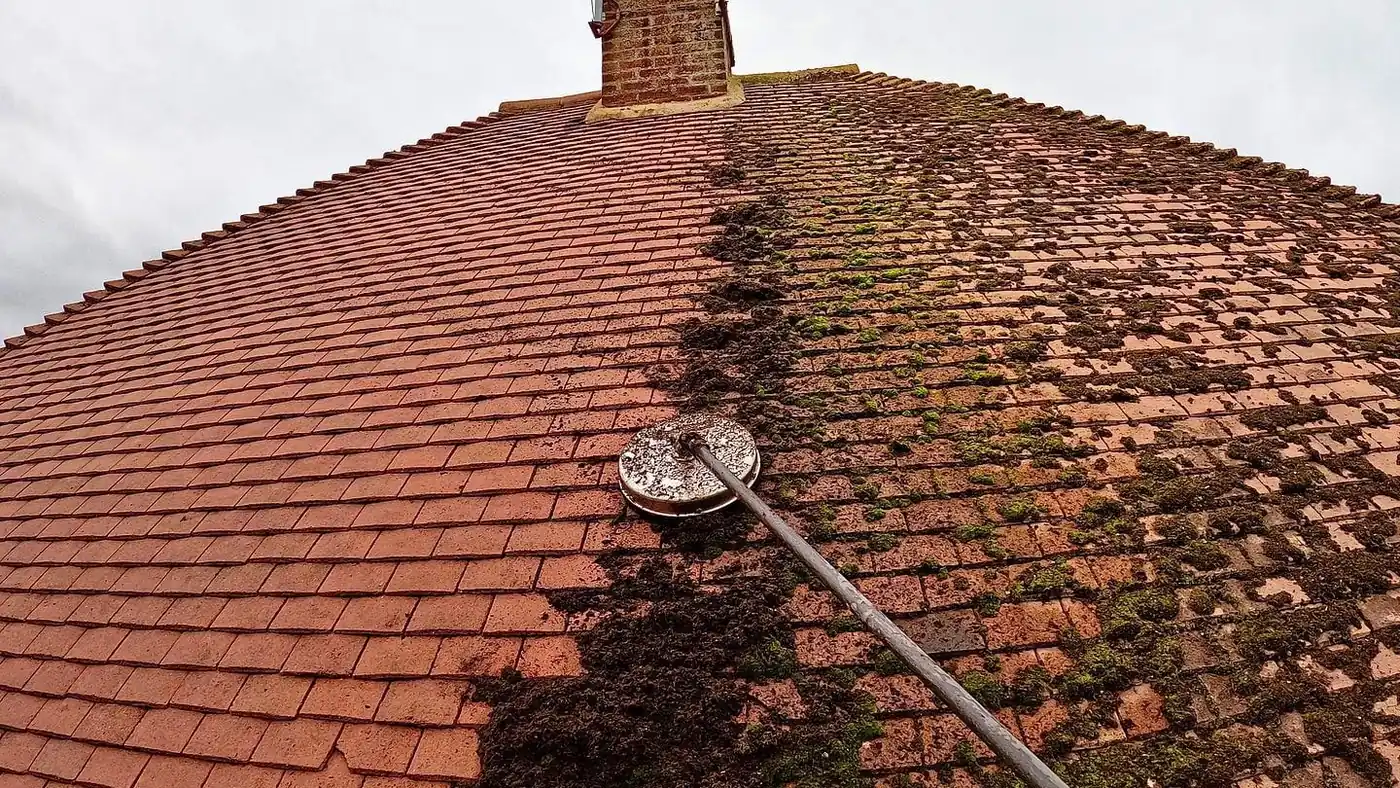
- Green algae on the roof
- Black lines on the tiles
- Clinging growth that would mark the tiles if scraped
Roof biocide treatment in Broom Street, done properly
A biocide treatment is what keeps a cleaned roof clearer for longer. The treatment reaches the spores and traces of growth that hand removal leaves behind, and slows regrowth. How long it lasts depends on shade and aspect, typically around one to a few years. If you have crusty grey and yellow lichen and algae on an older roof, we can help.
Some homes in villages like Broom Street are listed or in a conservation area, which makes gentle cleaning even more important. For anything beyond cleaning, such as a coating, the council’s conservation officer is the person to ask first.
The guarantee is not a handshake. Each job comes with a written 12-month workmanship guarantee, covering the work we carried out. File it with your other house papers for reference.
- Where
- Broom Street (ME13)
- Region
- Kent
- Our guarantee
- 12-month workmanship guarantee, in writing
- Quotes
- One fixed price, quoted in advance
- Background
- Checkatrade member, fully insured
- Telephone
- 01342 344 936
- Updated
- 30 October 2026
Why it’s worth doing now in Broom Street
An early treatment saves bigger work later. Thin growth responds well, while years of build-up need removing first. It takes a few hours on the day, while the treated growth weathers away over the following months. Old materials can be hard to replace like for like, which makes looking after them worthwhile.
What you pay reflects the actual work. That’s why we look at the job first, from pictures or in person, and the price agreed before work begins.
What you get with us
- One phone number across our whole area
- We’re fully insured
- Workmanship guaranteed in writing for 12 months
- The gentlest method that does the job
How we price roof biocide treatment
We look at the job before pricing it. We consider:
- Repairs found during the job, quoted before they are done
- Any towers, scaffold or powered access
- The height and pitch, where the work is above ground
- Access from the road to the work
The cost depends on the size of the area, how easy it is to reach and how much build-up there is. We give you a fixed price before any work starts, so there are no surprises.
Asking for a quote
To help us quote quickly, send us:
- What sits underneath, like a glass roof or flat-roofed extension
- Parking near the property
- Problems you’ve spotted, like loose tiles or water spilling from gutters
- Details of any previous treatment
The quickest way to a quote is often a few pictures: a wide shot of the whole area, a closer one of the worst part and one showing how we’d get to it. There’s no need to climb anything; the garden or an upstairs window is fine.
What roof biocide treatment looks like in Broom Street
The coast is only about 2 miles from Broom Street. Crusty lichen is a common sight on roofs near the sea, and because scraping it can mark the tiles, a biocide is the usual answer. The Rough, roughly 0.2 miles west of Broom Street, is the nearest of about 5 ancient woods within a couple of miles of Broom Street. Woods nearby can mean leaves on the tiles and shade for much of the day, and moss does well in both. With central London about 46 miles off, Broom Street is one of the many South East places on our list for roof biocide treatment. With 20 years’ experience, we are fully insured and a Checkatrade member.
Period houses close to churches such as Church of All Saints tend to have clay or slate on top, and we only ever clean that kind of roof by hand. If your home backs onto green space such as South Swale, 1.6 miles north-east of Broom Street, you are likely to see more shade, leaves and bird droppings. Where a slope gets little sun, moss usually comes back quicker after a clean.
Broom Street is about 2 miles east of Faversham, in Kent. We treat roof biocide treatment in Broom Street the same as anywhere in Kent: a fixed price first, careful work, a full clear-up and a written 12-month workmanship guarantee. Broom Street is one of 922 places in Kent where we work for homeowners and landlords. Our Maidstone page covers homes nearby, about 18 miles away.
Every address in ME13 is covered for roof biocide treatment, from busy streets to back roads. We also cover the places around Broom Street: Graveney (1 mile south-east), Culmers (1 mile south-east), Goodnestone (1 mile south), Slutshole (2 miles south-east) and Hernhill (2 miles south-east). Further out, we also cover Ashford (13 miles south), Canterbury (7 miles south-east), Sittingbourne (9 miles west), Whitstable (5 miles north-east), Herne Bay (9 miles east) and Minster (9 miles north-west).
Around Broom Street
In Broom Street, the houses around South Swale and Queen Elizabeth's Grammar School sit inside the area we work in. For rail, the closest station is Faversham station, roughly 2.1 miles south-west of the centre.
What a clean won’t put right
A few issues sit outside what this work can do:
- Heavy moss cushions
- Broken ridge mortar
- Lichen vanishing on the day
If you are not sure, just get in touch on 01342 344 936, or by the quote form and we’ll give you a straight answer.
What we clean
- Shaded roof slopes
- Roofs cleaned by hand
- Ridge and hip tiles
- Algae and black streaks
- Lichen patches
- Tile and slate surfaces
When to call us in Broom Street
Lichen grows where the air and roof suit it, often slowly over many years. It grips the surface firmly which is why a biocide is the usual answer.
From the garden or the street, you might notice:
- A roof cleaned a few years ago that needs retreating
- Growth on tiles too fragile to scrape hard
- New moss on a cleaned roof
- Black streaks down the slopes
Living close to Graveney Primary School can mean parked cars and crowds at the start and end of the school day. It’s worth a mention when you book, as the van and ladders need space outside.
Before booking anyone
- What access equipment they’ll use, if any
- How long their workmanship guarantee lasts
- Whether the figure could change on the day
- The method they’ll use, and why it suits your surface
Keeping it in good shape
After the work, a few habits help it last:
- Check gutters after heavy rain
- Expect gradual change
- Never scrape lichen yourself
- Cut back overhanging trees
After a biocide treatment, nothing much seems to happen at first. Dead growth fades gradually as the weather works on it and the roof keeps improving. We will tell you what to expect.
Cut back trees that shade the tiles. Sun and air dry the roof faster after rain and the gutters stay clearer.
Can I do it myself?
Patios and driveways are the one area many people clean themselves, and there’s nothing wrong with that. Mind the run-off, though: surface water drains run straight to the environment, so dirty water and cleaning products shouldn’t go down them.
Cleaning solar panels yourself is rarely worth the risk. The manufacturer’s care guidance comes first, and do not use a pressure washer or harsh chemicals. Since most panels are on a roof, the risk is the same as any roof work.
Broom Street: your questions answered
Does tree cover around Broom Street affect roof biocide treatment?
Trees can make a real difference. The nearest ancient woodland to Broom Street is The Rough, roughly 0.2 miles west of Broom Street. Leaves on the tiles and shade over the roof both keep it damp, and damp is what moss needs.
Do you work in villages like Broom Street?
Yes. Broom Street is within the area we cover across London and the South East. A few photos and directions help us plan the visit.
Where does the dirty water go?
We keep it out of the surface water drains. Those drains carry water straight to the environment, not to a treatment works, so only clean water belongs in them.
Do nesting birds affect the work?
The Wildlife and Countryside Act 1981 protects active nests, so we look before working near eaves, gutters or roof spaces. Tell us if you’ve seen birds going in and out when you get in touch.
Do you belong to any trade schemes?
Yes, we are members of Checkatrade. We’re fully insured too, with 20 years’ experience, plus a written 12-month workmanship guarantee on our work.
What precautions do you take with the biocide?
We protect plants, paths and drains below and follow the label’s precautions. Run-off is controlled and kept out of surface water drains and we will advise on keeping pets and children clear while it dries.
Can you price the job without visiting?
Often, yes. Clear photos taken from the ground, plus the address and what you’d like done, are often enough. Where the photos do not show enough, we come and look.
What about my pets and plants?
Not each job uses chemicals; solar panels, for instance, get soft brushes and clean water. Where a biocide is part of the job, it’s one approved or authorised for this use in Great Britain, applied as the label says. We will let you know how long to keep pets off treated areas.
Nearby places to Broom Street
More services for Broom Street
How it works
Where water is part of the job, we control where it goes. We do not let sludge, dirty water or biocide wash into the surface water drains, as surface water drains lead straight to the environment. On site, it takes an hour or two for a small roof and longer for a large one. Tell us about the route to your home in Broom Street, especially narrow lanes or gates.
- First we decide whether to treat or clean and treat.
- The price is fixed and the date chosen for dry weather.
- We protect drains and gullies first.
- Heavy growth comes off by hand, then the biocide is applied by soft wash.
- The area is cleaned down and precautions explained.
Preparing for the work
- Let us know about any pets, and keep them inside on the day
- Move garden furniture, pots and washing away from the work
- Park cars clear of the work area
Get a fixed quote
If you need roof biocide treatment in Broom Street, speak to us on 01342 344 936 or fill in the quote form. Tell us the address and what you’d like done, and mention anything that could affect access, like a conservatory below or a narrow side passage. A fixed quote follows from there.