Hampshire · Biocide roof treatment
Bridgemary roof biocide treatment
Biocide roof treatment in Bridgemary, done the careful way. We plan the access, protect the area and take the waste with us.
- A green film over the tiles
- New moss on a cleaned roof
- Lichen spots across the tiles
How we handle roof biocide treatment in Bridgemary
Cleaning takes growth off a roof; a biocide treatment helps keep it off. The treatment reaches the spores and traces of growth that hand removal leaves behind, and slows regrowth. How long it lasts depends on shade and aspect, typically around one to a few years. The work covers lichen patches, shaded roof slopes and tile and slate surfaces, and the jobs we see most are bright lichen patches on ridge and hip tiles and regrowth since the roof was last cleaned.
In a place like Bridgemary, you’ll often find older cottages alongside post-war houses and bungalows. Clay and slate on older homes are cleaned gently by hand, while concrete tiles on newer ones are more robust.
Each job gets the benefit of 20 years’ experience, and we’re fully insured and Checkatrade members. Each job also carries a written 12-month guarantee on our workmanship, set down in writing.
- Place
- Bridgemary (PO13, PO12)
- Region
- Hampshire
- Cover
- A written 12-month guarantee on our workmanship
- Quotes
- Fixed quote, agreed before any work
- Experience
- Checkatrade member with 20 years’ experience
- Call
- 01342 344 936
- Last updated
- 30 October 2026
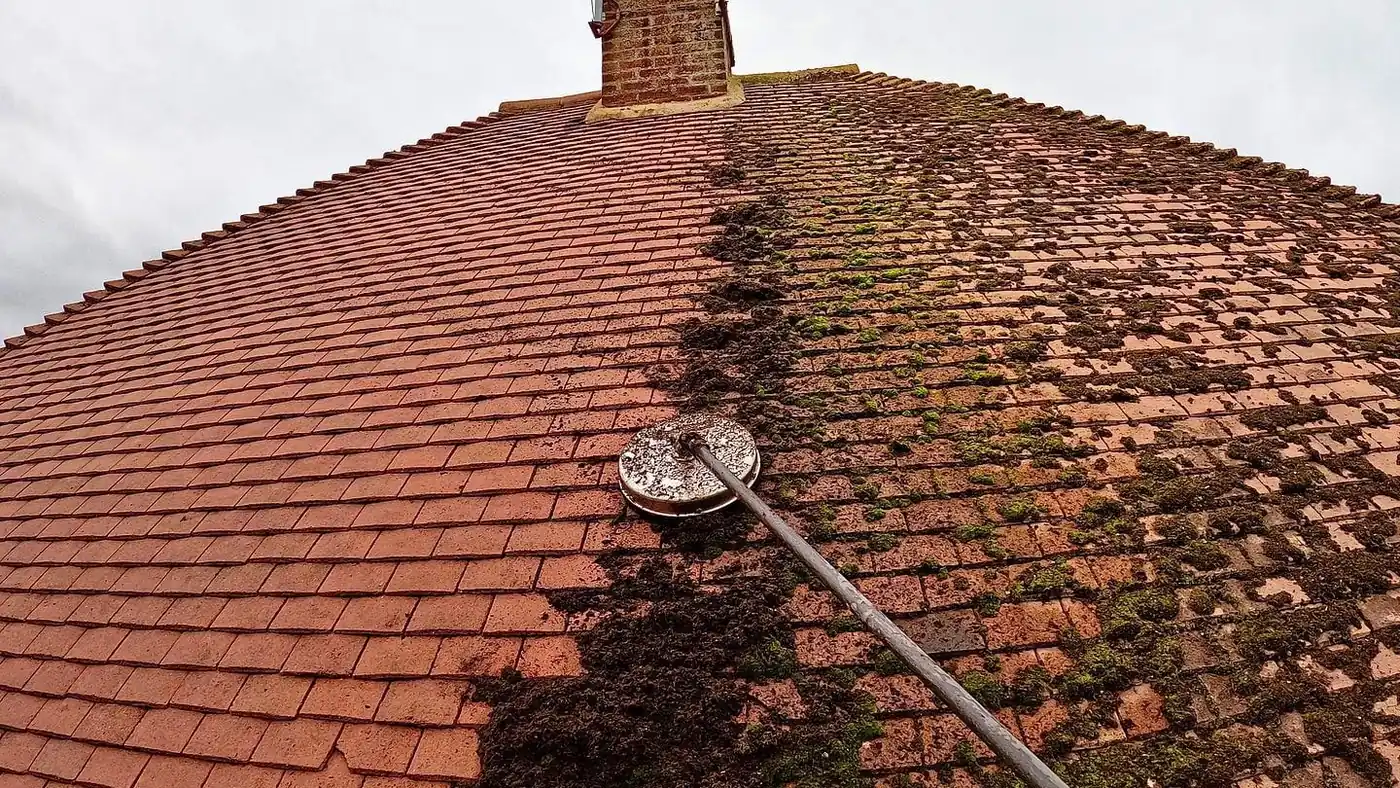
What we are called out for in Bridgemary
Lichen takes years to build up, but it’s stubborn once it does. It grips the surface firmly which is why a biocide is the usual answer.
The problems we’re asked about most are:
- Growth on delicate tiles that cannot be jet washed
- A roof cleaned a few years ago that needs retreating
- A north-facing slope that greens up fast
- Lichen spots across the tiles
If you live near St Matthew's, or on any of the older streets in Bridgemary, your roof may be clay or slate, which is cleaned gently by hand.
What your quote should include
- How they’ll reach the work safely
- How they’ll handle anything unexpected
- Whether the price is fixed
- Whether the quote shows VAT
Why deal with it now?
Treating a roof now keeps the next clean smaller. Light growth is quick to deal with but heavy moss needs a full clean. It takes a few hours to apply on most roofs. Where trees and hedges keep things shaded, growth returns faster, so regular care matters more.
What you pay reflects the actual work. That’s why every job is looked at first, and the price agreed before work begins.
What you get with us
- A full clear-up before we leave
- Safe access planned for every job
- One phone number across our whole area
- 20 years’ experience
See how roof cleaning is priced and our methods by tile type.
How the job changes from site to site
Clay tiles
Moss on clay tiles comes off by hand before treatment. The biocide then goes on at low pressure, and no pressure washing is involved.
Fibre cement slates
We look at fibre cement slates first. Older ones may contain asbestos, so they need a careful, low-impact approach, and we will advise on what’s suitable.
What a clean won’t put right
We’d rather tell you now than sell you work that will not help, so these are the things it won’t cover:
- Overnight change
- Deep moss in the interlocks
- Damaged tiles
If in doubt, pick up the phone and call 01342 344 936, or use the quote form and we will say what we think.
What we work on in Bridgemary
- Lichen patches
- Roofs cleaned by hand
- Algae and black streaks
- Tile and slate surfaces
- Ridge and hip tiles
- Shaded roof slopes
How the job works
The day has three parts: setting up, the work itself and the clear-up. Setting up covers protection, access and planning where any water will go, and the clear-up means sweeping, bagging the waste and taking it with us. The middle part takes longest, and that takes a few hours to apply on most roofs. Garden furniture and pots near the work are moved or covered first.
- We check the growth and the tiles before deciding the approach.
- You get a fixed quote that says what’s being treated.
- We plan the day around the weather, since the biocide needs a dry spell to work.
- We protect the area below and apply the biocide by soft wash.
- You’re told how the treated growth will weather off over time.
Helping the day go smoothly
- Keep pets indoors while we work
- Make space on the drive by moving cars
- Check with neighbours if we need to use a shared drive
Getting a quote
Getting a quote does not take long. Send a few details and pictures, and we will come back to you with a fixed price. Where we need a closer look, we arrange a time to come round.
Advice
Bridgemary questions
Does living near the coast affect roof biocide treatment in Bridgemary?
It can make a difference, with the sea only about 2 miles from Bridgemary. Damp, salty air can suit lichen, which is treated with biocide and left to weather rather than scraped.
I live in a conservation area in Bridgemary: does that affect roof biocide treatment?
For cleaning, very little changes, though we keep to gentle methods; a coating or anything that alters the roof’s look is one to check with Gosport council. The Rowner conservation area, about 0.6 miles south of the centre of Bridgemary, is the closest to Bridgemary.
What do you do with what you remove?
We take it away when we go. We sweep up and clear the area before leaving, leaving the place tidy.
Can you work on an old or listed property?
Yes. We use the gentlest methods on historic roofs and walls, such as careful hand removal and low-pressure steam where it suits. For anything that would change the appearance, such as a coating, check with the council first, because listed building consent can be needed for works affecting its special character.
Will the chemicals harm my garden?
Pets and plants are something we always plan for. We only use biocides approved or authorised for this use in Great Britain, as the law requires, and apply them as the label says, and plants below are protected. Please keep pets indoors on the day.
How long is a biocide treatment visit?
Size and access decide it. Typically it takes a few hours on the day, while the treated growth weathers away over the following months and the results build for months.
Do you need scaffolding?
For some jobs, yes. Lots of work can be reached safely with ladders and roof ladders, but height, pitch or a conservatory below can mean a tower, scaffold or powered access. Whatever is needed goes into the fixed quote.
What does a biocide roof treatment do?
It kills growth so it can weather away. Lichen in particular is best treated this way, since scraping can damage tiles, and it slows regrowth after a clean.
Can I do it myself?
Please do not walk on the tiles. Tiles and slates can crack under your weight, sometimes with hairline cracks you cannot see, which frost can widen over time. Access should always be planned to suit the roof.
For a quick check from a ladder, set it on firm, level ground, have someone foot it and never lean out to the side. Don’t climb from the ladder onto the roof and never do it on your own.
Places near Bridgemary
Also in Bridgemary
What affects the cost of roof biocide treatment
A fixed price needs a few facts first. We check:
- More than one service on one quote
- Parking, and how far we carry equipment
- What’s below the work area
- The type and condition of the tiles or surface
You will not find a price list here, because each job is priced on what it involves. Call for a fixed quote, and we will explain what’s included.
Helping us quote
A few details help us quote accurately. When you get in touch, it helps to send:
- Any side gates, passages or tight spots we’d need to get through
- Whether there’s space on the drive or in the street
- Conservatories, porches or extensions under the area
- A few general shots from the garden or street
Photos are often the quickest route to a quote: a wide shot of the whole area, a closer one of the worst part and one showing how we’d get to it. There’s no need to climb anything; the garden or an upstairs window is fine.
Roofs in Bridgemary: local notes
The coast is only about 2 miles from Bridgemary. Wind off the sea drives rain into a roof, and the damp that follows suits algae and lichen as much as moss. Ancient woodland is a feature around Bridgemary: about 3 areas lie within two miles, the closest being The Wildgrounds, roughly 1 mile south of Bridgemary. Tree cover means shade, and shade means moss, so a roof near woods may need cleaning more frequently.
Homes on school roads, near Rowner Junior for instance, can face busy mornings and afternoons. A quick note about it when you book helps us plan where to unload. If your home backs onto green space such as West of the River Alver, 1.6 miles south of Bridgemary, you are likely to see more shade, leaves and bird droppings. Shade slows how quickly a roof dries, and a roof that stays damp suits moss.
Bridgemary is about 1 mile north-west of Gosport, in Hampshire. We carry out roof biocide treatment for houses, flats and rented homes in Bridgemary and the rest of Hampshire. Bridgemary is one of 683 places in Hampshire we cover for roof biocide treatment. There’s also a page for Guildford, roughly 39 miles from Bridgemary.
Here we cover the PO13 and PO12 postcode area for roof biocide treatment. You will find streets such as Camp Road, Copse Lane and Agnew Road, and we cover them all for roof biocide treatment. We also cover Rowner (1 mile north-west), Peel Common (1 mile west), Elson (1 mile south-east), Crofton (1 mile west) and Gosport (1 mile south-east). We also work in nearby towns such as Havant (9 miles east), Eastleigh (13 miles north-west), Fareham (3 miles north-west), Horndean (9 miles north-east), Chandler's Ford (15 miles north-west) and Hedge End (9 miles north-west).
Near you in Bridgemary
In Bridgemary, the houses around The Green Dragon pub and Bridgemary School are all within our usual area. Bridgemary’s nearest station is Fareham station, about 2.5 miles north-west of the centre. Other landmarks nearby include Portchester Castle (2.7 miles north-east) and Search (2.6 miles south-east). Green spaces nearby include West of the River Alver and Portsdown Hill.