Kent · Biocide roof treatment
Roof Biocide Treatment in Bluetown
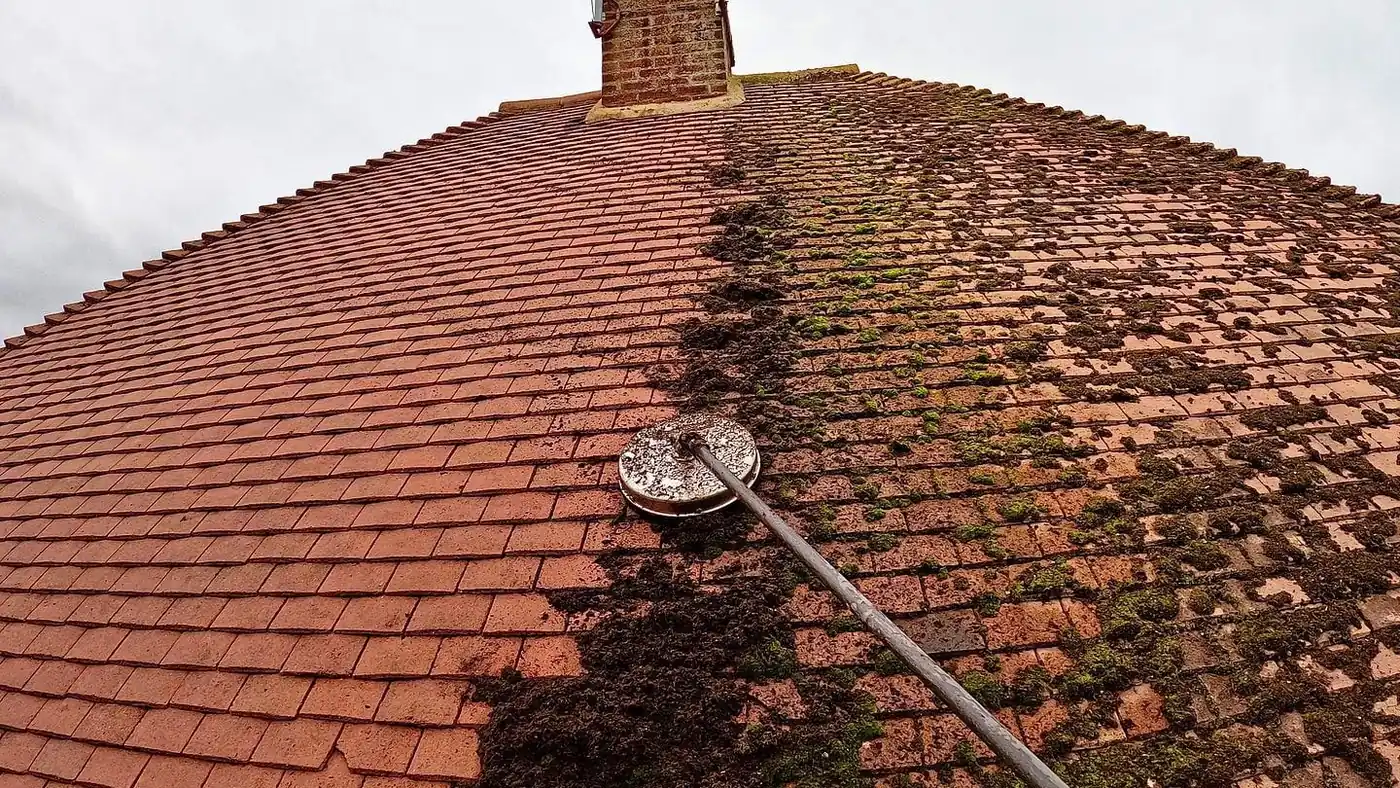
Biocide roof treatment to kill remaining moss, algae and lichen spores and slow regrowth in Bluetown, with your property protected throughout. Safe access planned for the job, the area protected and the waste taken away.
- Light moss starting to show
- Lichen spots across the tiles
- A north-facing slope that greens up fast
How we handle roof biocide treatment in Bluetown
Twenty years in roof cleaning has made us honest about treatments. It slows regrowth; it isn’t permanent and dead growth takes time to weather away. The work is fully insured, backed by a 12-month written guarantee covering our workmanship, and we are a Checkatrade member. The work covers lichen patches, ridge and hip tiles and shaded roof slopes, and people most often call us about green algae on the roof and lichen on clay or slate.
Long drives, lanes and big gardens are part of working in a village like Bluetown, so tell us about the route and where we can park when you book. Trees around rural homes often mean more shade, more moss and more leaves in the gutters.
It’s worth knowing exactly what a guarantee covers. Ours is a written 12-month workmanship guarantee, and it covers the quality of our work. Nobody can honestly promise that growth or dirt won’t come back outdoors, so we do not.
- Where
- Bluetown (ME9)
- Region
- Kent
- Our guarantee
- Workmanship guaranteed in writing for 12 months
- Price
- Fixed, not estimated
- Experience
- Checkatrade member, fully insured
- Phone
- 01342 344 936
- Page updated
- 30 October 2026
What a clean won’t put right
We won’t book work that does not solve the problem, so these are the things it will not cover:
- Lichen vanishing on the day
- Cracked, slipped or missing tiles (repairs are quoted separately)
- A roof that stays clear forever
If you are not sure, just use the quote form or phone 01342 344 936 and we will give you a straight answer.
What we clean
- Shaded roof slopes
- Tile and slate surfaces
- Lichen patches
- Ridge and hip tiles
- Algae and black streaks
- Roofs cleaned by hand
How it works
Where cleaning is involved, we use the gentlest effective method, matched to the surface in front of us. We do not reach for more pressure just because it’s quicker. The work itself takes a few hours to apply on most roofs, and the area is left tidy. Bigger gardens and outbuildings mean it’s worth telling us what’s included and how we reach it.
- We look at the roof and the growth on it.
- We fix the price and agree any hand removal first.
- A dry day is chosen and plants, paths and drains are protected.
- The biocide goes on at low pressure, as the label directs.
- The site is cleared and you are told what to expect.
Getting ready for the day
- Keep pets indoors while we work
- Clear pots, furniture and washing lines from the area
- Park cars clear of the work area
Get a fixed quote
Photos are often the quickest route to a quote: a wide shot of the whole area, a closer one of the worst part and one showing how we’d get to it. There’s no need to climb anything; the garden or an upstairs window is fine.
Read more
For landlords and letting agents
For blocks of flats and other shared buildings, outside work is often arranged by the freeholder or managing agent. We can quote for the whole building and deal with whoever is in charge.
Between tenancies is often a good time for outside work because access is easy then. Let us know the window you’re working to and we’ll try to fit around it.
Doing it yourself: an honest view
Please do not walk on the tiles. Tiles and slates can crack under your weight, sometimes with hairline cracks you cannot see, which frost can widen over time. Access should always be planned to suit the roof.
Roof work is dangerous, and not only for amateurs. HSE says almost one in five deaths in construction work involve roof work, and its advice is to treat every roof as fragile until a competent person says otherwise. Anything that means going up onto a roof is best left to us.
Why deal with it now?
A clean and a biocide treatment aren’t the same thing. Hand removal takes off the moss on the day and the treatment deals with spores and slows it coming back. Many roofs benefit from both. Old materials can be hard to replace like for like, which makes looking after them worthwhile.
Whatever the property, the quote works the same way: how much there is, how we reach it, what state it’s in and how we’ll tackle it. Call for a fixed quote and we’ll go through it with you.
Why book with us
- The gentlest method that does the job
- A fixed quote before we start
- One number for London and the South East
- The waste bagged and taken away
Read how roof cleaning is priced or our methods by tile type.
Between visits
Checking things once a year makes a difference. Beyond that:
- Do not pick at dead lichen
- Keep off treated areas until they’ve dried
- Watch for new green patches
- Give the treatment time to work
Keep pets and children off treated areas until they’re dry, as we’ll advise on the day. The label sets out what’s needed and explain it before we leave.
A light brush down each season, as the SPAB recommends, keeps growth from settling. Only where it’s safe to reach the roof, but it makes each treatment go further.
What the work involves, part by part
Fibre cement slates
A low-pressure biocide avoids aggressive scraping and pressure. It’s often the most suitable approach, after a careful look.
Clay tiles
On clay, any thick moss is lifted by hand first. The biocide then goes on at low pressure, and no pressure washing is involved.
Common questions in Bluetown
Who should I ask about a listed home in Bluetown?
Bluetown comes under Swale council. Its planning or conservation team can tell you whether your home is listed or in a conservation area. A plain clean leaves a roof looking as it did; a coating or new tiles on a listed home are matters for the council.
I live in a conservation area in Bluetown: does that affect roof biocide treatment?
For cleaning, very little changes, though we keep to gentle methods; a coating or anything that alters the roof’s look is one to check with Swale council. There are about 5 conservation areas within a couple of miles of Bluetown, the nearest being the Milstead conservation area, roughly 0.9 miles north-west of central Bluetown.
What if you find a problem while you’re working?
We stop and talk to you. We never add work without asking; repairs are quoted first, at a fixed price. The price for the original job stays as agreed.
Do I need to tell my neighbours?
We take the same care next door as we do at yours. Splashes, debris and run-off are kept under control, and we only use their side with their permission.
Are the products you use a risk to pets and plants?
We take care with pets and plants. We only use biocides approved or authorised for this use in Great Britain, as the law requires, and apply them as the label says, and plants below are protected. Keep pets inside while we work.
Could the price change on the day?
Our quotes are fixed, not an estimate. That’s why we look at the job properly first, from pictures or on a visit.
Will a biocide get rid of lichen?
A biocide kills lichen, which then weathers off over time. It takes time, but the tiles aren’t harmed, and dead lichen gradually loosens and washes away.
Which biocides do you use on roofs?
We use only products approved or authorised for this use in Great Britain, as the law requires. The label is followed to the letter.
Roof biocide treatment in Bluetown: the local picture
Ancient woodland is a feature around Bluetown: about 60 areas lie within two miles, the closest being Mintching/Kingsdown Wood, some 0.3 miles north-east of Bluetown. Homes near woodland like this tend to get more shade and leaf litter, and moss grows best on damp, shaded roofs. Among the historic houses near Bluetown is Belmont House and Gardens, some 4.4 miles east of Bluetown. Buildings like that show how long clay and slate roofs can last when they are looked after. Central London is about 39 miles away, and Bluetown is firmly within our roof biocide treatment area. Every job carries a written guarantee on our workmanship for 12 months.
Around a church like Church of St Catherine, the houses are often some of the oldest in the area, and clay or slate on a roof like that gets scrapers and brushes, never a jet. Roads near schools such as Milstead and Frinsted Church of England Primary School can be busy at drop-off and pick-up. If that’s your street, mention it, and the ladders can go up before the road fills. Around Cromers Wood, about 1.6 miles north-west of Bluetown, gardens often border trees and hedges, and that brings shade. Where a slope gets little sun, moss normally comes back quicker after a clean.
Bluetown is about 4 miles south of Sittingbourne, in Kent. Whether you are in the middle of Bluetown or further out, roof biocide treatment is available for all kinds of property, from bungalows to large family homes. Bluetown is one of 922 towns, villages and districts in Kent we cover for homeowners and landlords. For properties nearby, see our Maidstone page, about 10 miles away.
Roof biocide treatment in ME9 is quoted and carried out the same way as anywhere else. We also cover the places around Bluetown: Hollybushes (1 mile west), Milstead (1 mile north-west), Doddington (1 mile south-east), Wichling (1 mile south) and Frinsted (2 miles west). We also work in nearby towns such as Maidstone (10 miles west), Ashford (12 miles south-east), Canterbury (14 miles east), Sittingbourne (4 miles north), Whitstable (13 miles east) and Faversham (6 miles east).
Near you in Bluetown
Locally, the streets close to Cromers Wood are all part of the area we cover. The nearest railway station is Sittingbourne station, roughly 3.6 miles north. A little further out are Newnham Castle (2.4 miles east) and Sittingbourne Heritage Museum (3.4 miles north).