Hertfordshire · Biocide roof treatment
Roof Biocide Treatment in Bishop's Stortford
For biocide roof treatment to kill remaining moss, algae and lichen spores and slow regrowth in Bishop's Stortford, one call is all it takes: quote, work and clear-up. Fully insured and a Checkatrade member.
- An old treatment that has worn off
- Regrowth since the roof was last cleaned
- Keeping a freshly cleaned roof clearer for longer
How we handle roof biocide treatment in Bishop's Stortford
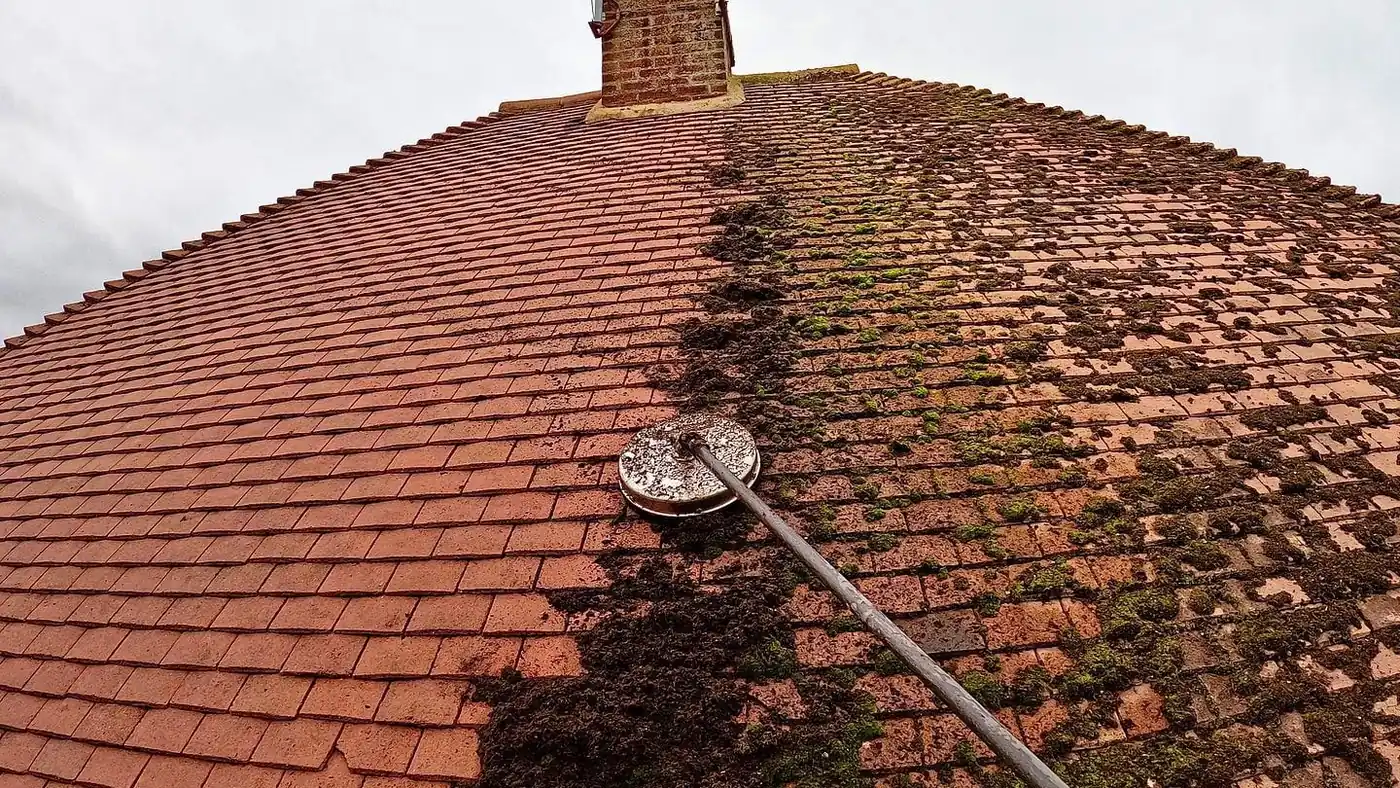
We apply the biocide by soft wash, at low pressure. Low pressure is safe for delicate tiles as well as robust ones since no water is driven into the laps. Thick moss is removed by hand first, so the biocide reaches the tile. Typical jobs include a north-facing slope that greens up fast and orange or yellow lichen on the ridge, on algae and black streaks, shaded roof slopes and ridge and hip tiles.
In a town like Bishop's Stortford, two neighbouring roofs can look very different, because shade, trees and aspect decide how quickly moss grows. A biocide wash after cleaning slows regrowth, though it is not permanent.
There are two kinds of protection when we work for you. Our full insurance is in place while we work, and the written 12-month workmanship guarantee covers the work once it’s done.
- Place
- Bishop's Stortford (CM23, CM22)
- Wider area
- Hertfordshire
- Cover
- Written 12-month workmanship guarantee
- Quotes
- A fixed quote up front
- Track record
- Two decades in the trade, fully insured
- Telephone
- 01342 344 936
- Last updated
- 30 October 2026
Let and managed properties
For anyone managing more than one property, the work can go on one quote. Every address is priced on its own job, so the figures are easy to follow.
Outside maintenance is easy to forget on a rental. Tenants do not often check the roof or gutters, so a planned visit helps spot build-up, blockages or loose tiles early.
Looking after it afterwards
How long the results last depends on shade, damp and care. We suggest:
- Do not wait for thick moss to return
- Look for regrowth on the shady slope once a year
- Let more sun reach the tiles
- Let the biocide stay on the tiles
After a biocide treatment, nothing much seems to happen at first. Dead growth fades gradually as the weather works on it and the roof keeps improving. We’ll tell you what to expect.
A light brush down each season, as the SPAB recommends, keeps growth from settling. Only where it’s safe to reach the roof, but it makes each treatment go further.
Different parts, different methods
Historic and listed roofs
Historic roofs need gentle handling, and a biocide is applied without force. We still check the roof closely first, and treat lichen rather than scraping it.
Natural slate
Lichen is common on slate. Slate can be scratched by scraping so a biocide is the gentle answer.
Step by step
When we arrive, we check the job matches what we quoted for. If anything is different, such as damage we couldn’t see before, we talk to you before carrying on. From there, it takes a few hours to apply on most roofs. Side access to the back garden decides where ladders or a tower go.
- We look at the roof to see whether it needs a clean before treatment.
- The treatment and a fixed price are agreed with you.
- We plan the day around the weather, since the biocide needs a dry spell to work.
- Gullies, plants and paths below are protected, then the biocide is applied at low pressure.
- We clear up and explain that the treatment works slowly, not overnight.
How to prepare
- Tell us about anything you already know, such as leaks or loose tiles
- Unlock any gates we will need to get through
- Let neighbours know if we will be near a shared boundary or drive
Getting a quote
Photos are enough for some jobs, while others need a visit. Big jobs, awkward access and anything that’s hard to see from the ground are normally looked at in person. Either way, you get a fixed price before we start.
Advice
Places near Bishop's Stortford
Other services in Bishop's Stortford
Why deal with it now?
A biocide isn’t permanent, whatever anyone tells you. How long depends on shade and aspect, typically around one to a few years as spores land on every roof. Treating again when regrowth appears is lighter work than starting from scratch. Cleaning what you have is almost always simpler than replacing it.
What you pay depends on the size of the area, the height and access and how much there is to clear. We give you a fixed price before any work starts, so there are no surprises.
Why choose Superior Roof Cleaning in Bishop's Stortford
- Full insurance on every job
- Biocides used as the law requires and as the label says
- A full clear-up before we leave
- Safe access planned for each job
Take a look at how our quotes work or our methods by tile type.
What’s safe to do yourself
Hard paving at ground level is a reasonable DIY job, and there’s nothing wrong with that. Just watch where the water goes: surface water drains run straight to the environment, so keep dirty water and chemicals out of them.
It’s easy to damage a surface while scraping moss. Lichen in particular clings hard, and forcing it off can mark the tile surface, so it’s better treated and allowed to weather off. Leave the roof to someone with the right access.
Bishop's Stortford roofs and what affects them
There are about 7 areas of ancient woodland within two miles of Bishop's Stortford, the nearest being Birchanger Wood, about 1.3 miles north-east of Bishop's Stortford. If your roof is shaded by trees, it will stay damp for longer and moss will usually come back sooner than on an open roof. Central London is about 28 miles away, and Bishop's Stortford is firmly within our roof biocide treatment area. Twenty years in the trade, full insurance and Checkatrade membership come with every visit. Older buildings in the area include Much Hadham Palace, about 3.6 miles west of Bishop's Stortford. They’re proof that a roof treated gently can stay in good order for a very long time.
Streets near a church such as Church of St Michael often include older homes, and older clay or slate roofs need hand cleaning rather than pressure. Roads within walking distance of a station like Bishops Stortford station, under half a mile from the middle of Bishop's Stortford, often fill with parked cars, so a word about parking when you book helps us plan. Homes near open spaces like Rushy Mead, roughly 1.1 miles south-east of Bishop's Stortford, often have more trees around them. A roof that sits in shade for part of the day tends to grow moss sooner.
Bishop's Stortford is in Hertfordshire. Homes in Bishop's Stortford get the same service as everywhere we cover: a fixed price, careful work, controlled run-off and a written 12-month workmanship guarantee. Our area takes in 381 places across Hertfordshire, from busy towns to small villages. You can also see our page for London, roughly 28 miles from Bishop's Stortford.
We cover every part of CM23 and CM22 for roof biocide treatment and the roads nearby. Whether your home is on Market Street, High Street and Station Road or anywhere close by, we can take on the work. Bishop's Stortford sits on or near the A120 and A1059, which makes travel easy for roof biocide treatment. Neighbouring places we cover for roof biocide treatment include Thorley Street (1 mile south), Thorley (1 mile south-west), Birchanger (2 miles north-east), Great Hallingbury (2 miles south-east) and Bury Green (2 miles west). Larger places within reach include Stevenage (15 miles west), Hoddesdon (11 miles south-west), Cheshunt (14 miles south-west), Hertford (11 miles south-west), Ware (9 miles south-west) and Broxbourne (11 miles south-west). As one of the bigger places in Hertfordshire, Bishop's Stortford has a wide mix of homes, all within our area for roof biocide treatment.
Landmarks near Bishop's Stortford
Properties near The Port Jackson pub and St Mary's Catholic School are on our patch, like the rest of Bishop's Stortford. There’s a railway station in Bishop's Stortford itself: Bishops Stortford station. Well-known places in the area include Bishops Stortford Local History Museum (1 mile north) and Moated mound (2.4 miles north-west). Not far away are Rushy Mead and Portingbury Hills.
Bishop's Stortford questions
How does a conservation area in Bishop's Stortford affect roof biocide treatment?
A clean leaves the roof looking as it should, so it isn’t the issue; new tiles or a coating are what East Hertfordshire council may need to agree. The nearest to Bishop's Stortford is the Bishop's Stortford conservation area, roughly 0.1 miles north-east of central Bishop's Stortford.
Who do I check with about listed building consent in Bishop's Stortford?
It’s East Hertfordshire council, the local council for Bishop's Stortford. Their conservation or planning staff can confirm the status of your home and what needs consent. For listed homes, the council’s conservation officer is the person to ask before anything beyond gentle cleaning.
How do you protect the garden during treatment?
The label decides the precautions, and we follow it. Plants and paving below are protected and drain outlets are protected and we will explain what to do while it dries.
What do you do with what you remove?
We take it away when we go. Paths, patios and drives are swept clear before we go, leaving the place tidy.
What if you find a problem while you’re working?
We stop and talk to you. Nothing extra is done without your agreement; repairs are quoted first, at a fixed price. The price for the original job stays as agreed.
Can you quote from photos?
Yes, if we can see what we need. If not, we come and look first, and the fixed quote follows.
Do you need special access equipment?
Not for each job. Every roof is treated as fragile until it’s confirmed otherwise, so we plan safe access before anything else, as the Work at Height Regulations 2005 require.
Can you treat lichen on a roof?
Lichen is best treated with a biocide and left to weather off. Scraping risks harming the tiles, because it’s bonded tightly, so treating it is the safer route. Expect it to fade gradually.
Fixed quotes for roof biocide treatment in Bishop's Stortford
The quote is worked out before the day. We base it on:
- The amount of build-up
- Any towers, scaffold or powered access
- The height and pitch, where the work is above ground
- Tile or surface type, and its condition
What you pay reflects the actual work. That’s why we look at the job first, from photos or in person, and why the quote is fixed before we start.
Helping us quote
Photos and some simple facts are often enough. Useful things to include:
- The parts that bother you most, zoomed in if your phone allows
- What sits underneath, like a glass roof or flat-roofed extension
- Where we could park, and any restrictions
- Whether the building is listed
Every quote starts with a look at the job, either from pictures you send or a visit to the property. After that, you get a fixed price before any work is booked.