Greater London · Biocide roof treatment
Roof Biocide Treatment in Avery Hill
Looking for roof biocide treatment in Avery Hill? We see the job first, fix the price and choose the gentlest method that does the job, then clear up and take the waste away.
- Regrowth since the roof was last cleaned
- Clinging growth that would mark the tiles if scraped
- A green film over the tiles
Roof biocide treatment in Avery Hill
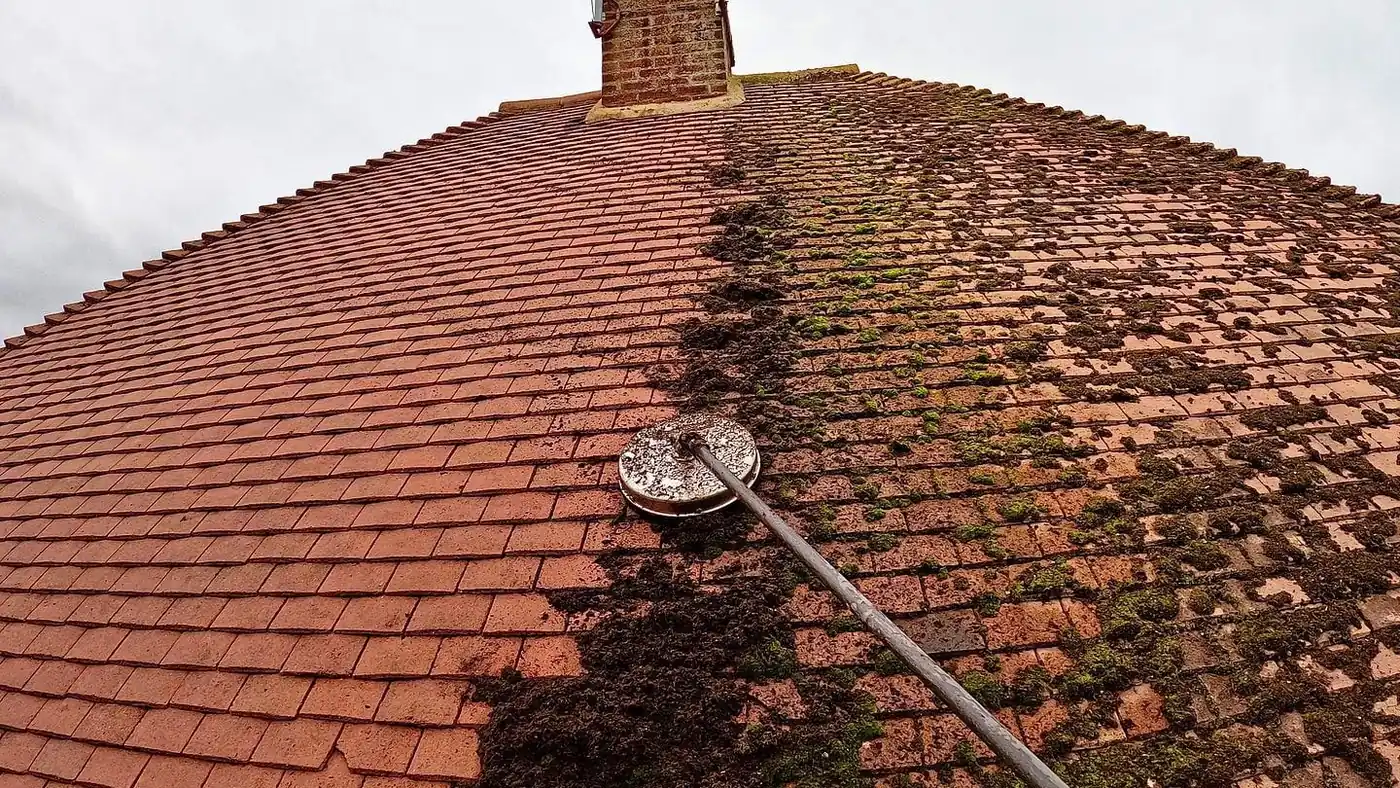
Some people have the roof treated as part of a clean; others book it separately. On a roof with light algae or lichen, a treatment alone may be enough but heavy moss always comes off by hand first. We’ll be honest about which your roof needs. The work covers shaded roof slopes, tile and slate surfaces and ridge and hip tiles, and the jobs we see most are lichen that won’t scrape off and algae on an older roof.
In a London neighbourhood like Avery Hill, access shapes the whole job: a roof ladder from the front, a tower in a narrow back garden, or a route through the house to reach the rear. If a scaffold or tower has to stand on the pavement, it may need a licence from the council, and a parking permit or bay suspension may be needed for the van. All of this is covered when we quote, so the day itself runs smoothly.
Our work comes with a written guarantee on our workmanship for 12 months, set out on paper. It covers the work we do, and we are fully insured as well.
- Where
- Avery Hill (SE9, DA15, DA16)
- Wider area
- Greater London
- Guarantee
- Written 12-month workmanship guarantee
- Quote
- One fixed price, quoted in advance
- Background
- Checkatrade member with 20 years’ experience
- Telephone
- 01342 344 936
- Last updated
- 30 October 2026
Doing it yourself: an honest view
Solar panels need particular care. Follow the panel maker’s care guidance, and don’t use a pressure washer or harsh chemicals. Since most panels are on a roof, the risk is the same as any roof work.
Hard paving at ground level is a reasonable DIY job, and that’s fine. Just watch where the water goes: surface water drains run straight to the environment, so dirty water and cleaning products shouldn’t go down them.
How the job works
The day has three parts: getting ready, doing the work and clearing up. Setting up covers protection, access and planning where any water will go, while clearing up means bagging the waste and taking it away. Most of the time goes on the work, and that takes a few hours on the day, while the treated growth weathers away over the following months. Anything placed on the pavement in London, such as a tower, may need the council’s permission.
- We check the growth and the tiles before deciding the approach.
- We fix the price and agree which slopes are treated.
- The date is set for dry weather, following the label.
- We protect the area below and apply the biocide by soft wash.
- You are told how the treated growth will weather off over time.
How to prepare
- Take in any washing and move pots out of the way
- Tell us if you’ve seen birds nesting in the roof or gutters
- Make sure we can get to the side and back of the property
Get a fixed quote
Need a price for roof biocide treatment? Please get in touch on 01342 344 936, or through the quote form and tell us about the property. We will explain the method we’d use and send you a fixed quote before you commit to anything.
Advice
Landlords, letting agents and property managers
We work for landlords, letting agents and property managers, not only owner-occupiers. If a tenant lives there, we can agree access with them or through you, as suits you.
Outside maintenance is easy to forget on a rental. Few tenants look up at the roof or into the gutters, so planned work helps catch moss, blockages or slipped tiles before they grow into a bigger job.
Between visits
Simple habits between visits make a real difference. We recommend:
- Cut back overhanging trees
- Check the roof annually
- Never scrape lichen yourself
- Keep off treated areas until they’ve dried
Your treatment comes with a written 12-month workmanship guarantee. It’s about our workmanship rather than a regrowth guarantee, since no biocide is permanent.
Keep gutters and downpipes clear. Blocked gutters keep the lowest tiles wet, which is where regrowth often starts.
Avery Hill roofs and what affects them
Avery Hill has about 11 conservation areas within a couple of miles; the closest is the Willersley Avenue and Braundton Avenue conservation area, some 1.1 miles south-east of the middle of Avery Hill. Being in a conservation area does not stop a roof being cleaned, and Greenwich council is the one to ask about anything that would change its look. Some London homes have slate on the main roof and a different tile on a later extension, and each is cleaned to suit. Older buildings in the area include Eltham Palace, some 1.2 miles west of Avery Hill. They are proof that a roof treated gently can stay in good order for a very long time.
Streets near stations such as Falconwood station, about 0.6 miles north of Avery Hill, can be busy with commuter parking, so a word about parking when you book helps us plan. Roads near schools such as Stationers' Crown Woods Academy can be busy at drop-off and pick-up. If that’s your street, mention it, and the ladders can go up before the road fills.
Avery Hill is about 1 mile north-east of Eltham, in Greater London. Roof biocide treatment in Avery Hill is quoted and carried out the same way as everywhere else: a fixed price first, careful work, a full clear-up and a written guarantee on our workmanship for 12 months. Avery Hill is one of 764 places in Greater London we cover for roof biocide treatment. You can also see our page for London, roughly 8 miles from Avery Hill.
Work in SE9, DA15 and DA16 follows the same fixed quote, careful work and written 12-month workmanship guarantee as everywhere else we cover. Roof biocide treatment is available to homes on Bexley Road, Glenure Road and Perpins Road and nearby roads. Main roads around Avery Hill include the A210, so getting to you is simple for the job. We also cover the places around Avery Hill: Blackfen (1 mile east), Eltham (1 mile south-west), New Eltham (1 mile south), Falconwood (1 mile north-east) and Well Hall (1 mile west). Within a short drive, we also cover London (8 miles north-west), City of Westminster (11 miles north-west), Marylebone (11 miles north-west), Kensington (12 miles west), St Pancras (10 miles north-west) and Shoreditch (8 miles north-west).
Near you in Avery Hill
In Avery Hill, the houses around Shoulder of Mutton Green and Alderwood Primary School are on our patch, like the rest of Avery Hill. Avery Hill’s nearest station is Falconwood station, about 0.6 miles north. Well-known places in the area include Greenwich Castle (3.8 miles north-west) and Broadway Shopping Centre (3 miles east). Open spaces near Avery Hill include Summer Hill and The Tarn.
Do you need roof biocide treatment in Avery Hill?
Shaded, slow-drying slopes regrow fastest. Slopes out of the sun dry slowly and they need treating most often.
Signs it’s time to call us include:
- A shaded slope that turns green quickly
- A roof greening up
- Lichen spots across the tiles
- Clinging growth that would mark the tiles if scraped
Live on one of the older roads by Church of Holy Trinity? Clay tiles and slate are common on homes like yours, and both are treated gently.
What to look for in a quote
- What access equipment they’ll use, if any
- What happens to the moss and debris
- The method they’ll use, and why it suits your surface
- How they’ll keep drains, plants and paths protected
Also near Avery Hill
What else we do in Avery Hill
Your questions about roof biocide treatment in Avery Hill
Who can tell me if my home in Avery Hill is listed?
It’s Greenwich council, the local council for Avery Hill. They can confirm whether your home is listed or in a conservation area. A plain clean leaves a roof looking as it did; a coating or new tiles on a listed home are matters for the council.
Does tree cover around Avery Hill affect roof biocide treatment?
It often does. Ancient woodland such as Sheperdleas Wood lies roughly 0.6 miles north of Avery Hill. Trees mean shade and leaf litter, so moss normally comes back sooner and gutters fill faster.
Will the work affect next door?
It’s a good idea to let them know, especially if we will be near the boundary or parking nearby. Their windows, cars and paths get the same protection as yours.
Will a biocide get rid of lichen?
We treat lichen and let the weather remove it. Scraping risks harming the tiles, because it’s bonded tightly, so treating it is the safer route. Expect it to fade gradually.
Are you insured?
Yes, we are fully insured. We are Checkatrade members too and have 20 years’ experience.
Where does the waste go?
We take it away at the end of the job. We sweep up and clear the area before leaving, so the property is left tidy.
Are the products you use a risk to pets and plants?
We take care with pets and plants. Where a biocide is used, it’s one approved or authorised for this use in Great Britain, applied as the label says, and plants below are protected. Please keep pets indoors on the day.
Are your biocides legal to use?
Only biocides approved or authorised for this use in Great Britain, as the law requires. We apply them by soft wash, as the label says and run-off controlled.
What happens if it’s left?
Scraping lichen and treating it give very different results. Because it bonds to the tile, scraping can damage it whereas a treatment lets it fade without harm. In a terrace in Avery Hill, a problem left on your side can soon reach next door.
We don’t list prices on the website, because the cost depends on the job in front of us. Call for a fixed quote, and we will explain what’s included.
What you get with us
- Biocides used as the law requires and as the label says
- Fully insured
- A 12-month workmanship guarantee in writing
- A fixed price, not an estimate
Read how our quotes work and our methods by tile type.
What the work involves, part by part
Clay tiles
Mature clay tiles often carry lichen. Treating it avoids scraping the tile face and the weather does the rest.
Concrete tiles
Treating concrete tiles avoids stripping their colour. It’s applied at low pressure and does its work over time.